🏛️ Ethereum: Wall Street’s Settlement Layer - Why Institutions Are Building On It
As tokenization, stablecoins, and blockchain finance continue expanding, Ethereum is increasingly becoming the infrastructure layer many institutions are quietly building on.

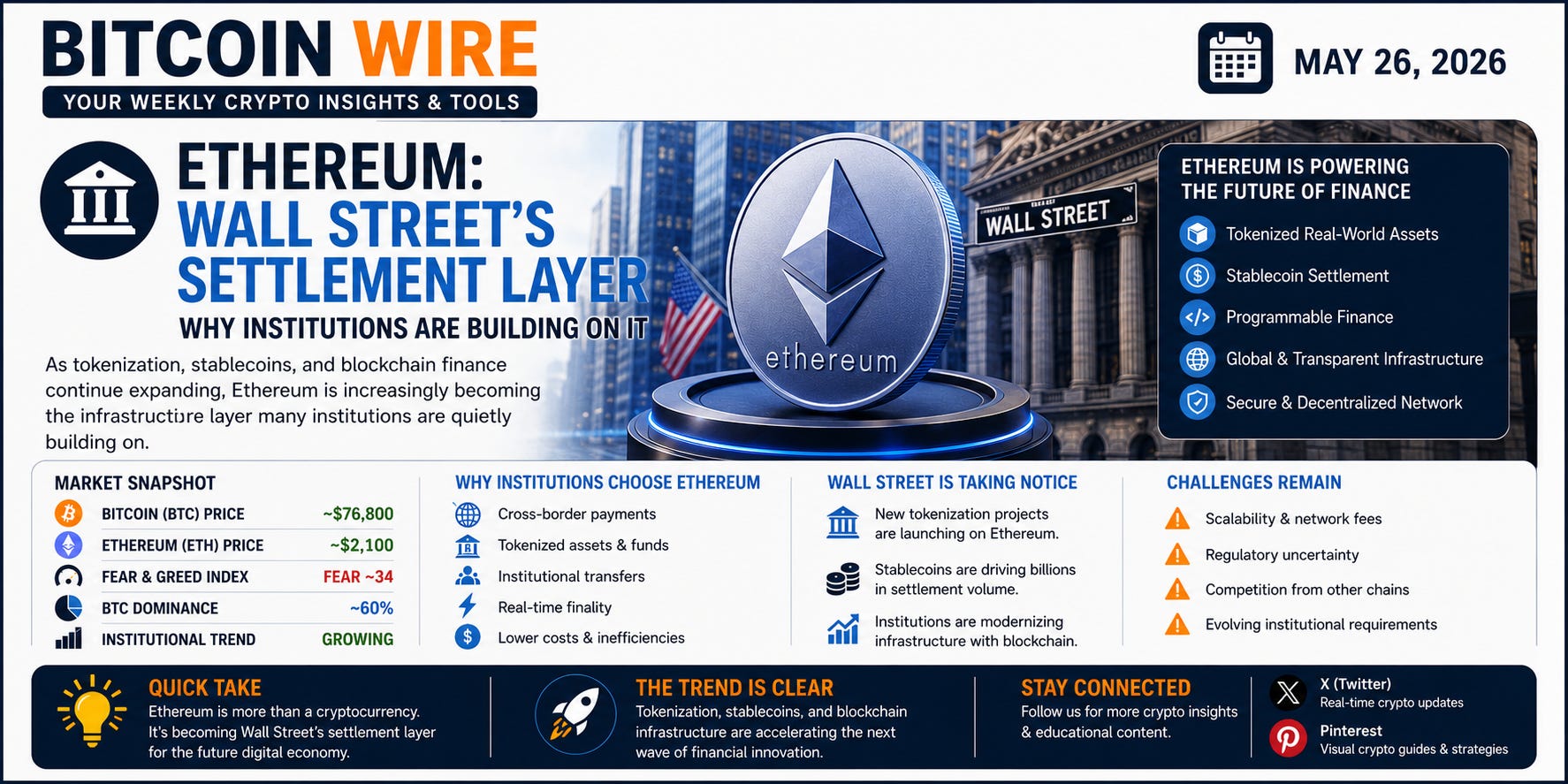
📊 Market Snapshot
💰 Bitcoin (BTC) Price: ~$76,800
💰 Ethereum (ETH) Price: ~$2,100
😐 Fear & Greed Index: Fear ~34
📈 BTC Dominance: ~60%
🏦 Institutional Trend: Growing Ethereum adoption
👉 Institutions are increasingly exploring blockchain settlement infrastructure.
📰 Industry Update 🥺
⚫ Ondo Finance founder & CEO Nathan Allman reportedly passed away unexpectedly on May 26, 2026. Ondo Finance has become one of the largest names in the RWA/tokenization sector, making the news highly significant for institutional crypto markets and blockchain finance discussions.
Ethereum is no longer viewed only as a cryptocurrency.
In 2026, many institutions now see Ethereum as:
🏦 financial infrastructure
⚡ a settlement network
🌍 a tokenization layer
📄 programmable finance technology
This shift is becoming one of the biggest stories shaping the future of blockchain adoption.
Let’s break it down 👇
💡 Why Institutions Are Paying Attention to Ethereum
For years, Ethereum was mainly associated with:
✔ DeFi
✔ NFTs
✔ smart contracts
✔ crypto applications
However, the narrative is evolving rapidly.
Today, institutions are increasingly exploring Ethereum for:
🏦 tokenized assets
💵 stablecoin settlement
📄 on-chain financial products
🌍 global transactions
⚡ programmable payments
👉 Ethereum is gradually becoming part of the broader financial infrastructure conversation.
🏗️ What Does “Settlement Layer” Actually Mean?
In traditional finance, settlement refers to:
✔ finalizing transactions
✔ moving ownership
✔ transferring value securely
Banks and financial institutions rely on complex systems to process settlements between:
🏦 banks
📈 brokers
💳 payment networks
🌍 international institutions
Ethereum introduces a blockchain-based alternative where transactions can settle:
⚡ globally
🌍 transparently
📄 programmatically
🔐 without traditional intermediaries
This is one reason Ethereum is gaining institutional attention.
🌍 Tokenization Is Accelerating Ethereum Adoption
One of the biggest trends in 2026 is:
🏗️ Real-World Asset (RWA) tokenization
Institutions are increasingly exploring tokenization for:
🏢 real estate
📄 bonds
💰 funds
🏦 private credit
🌍 financial assets
Ethereum’s smart contract infrastructure allows these assets to become:
✔ programmable
✔ tradable
✔ transparent
✔ globally accessible
👉 Many tokenization projects are being built directly on Ethereum-compatible systems.
💵 Stablecoins Are Strengthening Ethereum’s Role
Stablecoins have become one of crypto’s largest real-world use cases.
Today, billions of dollars move through:
💵 USDT
💵 USDC
💵 tokenized payment systems
Ethereum remains one of the largest settlement networks for stablecoin activity. Many investors now use major exchanges like Binance, KuCoin, WazirX and Pionex to access Ethereum markets, stablecoins, and blockchain-based financial products more efficiently.
Supporters believe stablecoins may eventually transform:
🌍 cross-border payments
🏦 banking infrastructure
⚡ settlement speed
📄 digital commerce
👉 This is increasing Ethereum’s importance inside institutional finance discussions.
🏦 Why Wall Street Is Exploring Blockchain Infrastructure
Large financial firms are no longer ignoring blockchain technology.
Today, institutions are increasingly researching:
✔ tokenized funds
✔ blockchain settlement
✔ digital asset custody
✔ on-chain trading systems
✔ programmable finance
Some firms believe blockchain systems may eventually reduce:
⚠ settlement delays
⚠ administrative costs
⚠ reconciliation complexity
⚠ financial inefficiencies
Ethereum is often viewed as one of the leading platforms capable of supporting these systems.
⚠️ Ethereum Still Faces Major Challenges
Despite growing adoption, Ethereum still faces important obstacles.
These include:
⚠ scalability concerns
⚠ regulatory uncertainty
⚠ network congestion
⚠ competition from other blockchains(Solana vs Ethereum)
⚠ evolving institutional requirements
Critics also argue:
📉 high fees can reduce efficiency
⚡ alternative chains may scale faster
🏦 governments may impose stricter oversight
👉 Institutional adoption is still evolving and far from guaranteed.
🔐 Why This Matters for Crypto Investors
As institutional adoption grows, many retail investors are also exploring Ethereum through regulated exchanges, automated trading platforms, and long-term investment strategies.
Institutional Ethereum adoption could influence:
📈 long-term demand
🏦 market legitimacy
🌍 blockchain adoption
⚡ tokenization growth
💵 stablecoin infrastructure
For many investors, Ethereum is increasingly viewed as:
✔ a technology platform
✔ financial infrastructure
✔ a settlement network
✔ a long-term blockchain ecosystem
This narrative is becoming far larger than simple cryptocurrency speculation.
📚 Related Reads
🔹 Ethereum Wall Street’s Settlement Layer - Why Institutions Are Building On It
https://bitcoinpricecomparison.com/ethereum-wall-streets-settlement-layer/
🔹 BlackRock’s Tokenization Strategy: Rebuilding Wall Street On-Chain
https://bitcoinpricecomparison.com/blackrock-tokenization-strategy/
🔹 RWA Tokenization: Why Your Next Dividend Might Come from a Warehouse
https://bitcoinpricecomparison.com/rwa-tokenization-benefits-2026-dividends/
🔹 The Tokenization Era: Why Everything Is Moving On-Chain
https://bitcoinpricecomparison.com/tokenization-era/
⚡ Quick Take
👉 Ethereum is increasingly evolving beyond a crypto asset.
For many institutions, it is becoming:
✔ settlement infrastructure
✔ tokenization technology
✔ programmable finance rails
✔ part of the future financial system
🚀 Final Thought
Ethereum’s growing role inside institutional finance may become one of the most important blockchain trends of the decade.
As tokenization, stablecoins, and digital settlement systems expand globally, Ethereum could increasingly function as the infrastructure layer powering parts of the future digital economy.
🌐 Stay Connected
👉 Follow us for more crypto insights & educational content:
𝕏 (Twitter) – Real-time crypto updates
📌 Pinterest – Visual crypto guides & strategies